


The story of Elsa the Lioness is undoubtedly the main attraction to Meru National Park. Conservationist couple Joy and George Adamson raised a lion cub, Elsa, and eventually released her back into the wild; a story that inspired the book and film, Born Free. Meru has an 84 sq km rhino sanctuary that is home to a number of both white and black rhino. It is open to visitors and is particularly close to Elsa's Kopje Camp. Other attractions in the park include the beautiful landscape. Mt Kenya is clearly visible from the park.
Meru National Park has a wide range of wildlife including elephant, lion, leopard, cheetah, black rhino and hippo. Buffalo, oryx, oribi, zebra, giraffe, hartebeest, impala, kudu, mongoose, warthog, dik dik, civet, caracal, wild dog, baboons, hyena and vervet monkeys can also be spotted. Meru National Park is also to home to an abundance of birdlife that includes Pel's fishing owl, Peter's finfoot which inhabits the Murera and Ura Rivers.
Meru is home to the Big Five. Elephants migrate through the park and big herds can sometimes be encountered. Big cats are more difficult to spot, but it isn’t rare to have a sighting all to yourself: watch for leopards along the Rojewero River. You’ll see lots of waterbuck and hippo. Northern Kenya specials include the Beisa oryx, the stunning reticulated giraffe (often in large family groups) and the gerenuk. As you drive into the park for the first time, it’s hard not to fall in love with the dramatic scenery: distant hills rise from the horizon with tall doum palms silhouetted against the sky. The Rojewero and Tana Rivers are lined with lush vegetation, and the palms, baobab trees and red soil provide a striking background for the park’s many animals.
Meru is developing a reputation for lion and leopard sightings (look for the latter draped along a branch close to the rivers). Meru is also known for its northern Kenyan specials, which are specially adapted to arid conditions. The reticulated giraffe is distinguishable by its dramatic pattern. This is one of few places to encounter the shy lesser kudu, the impressive-looking Beisa oryx, and the gerenuk with its elongated neck.
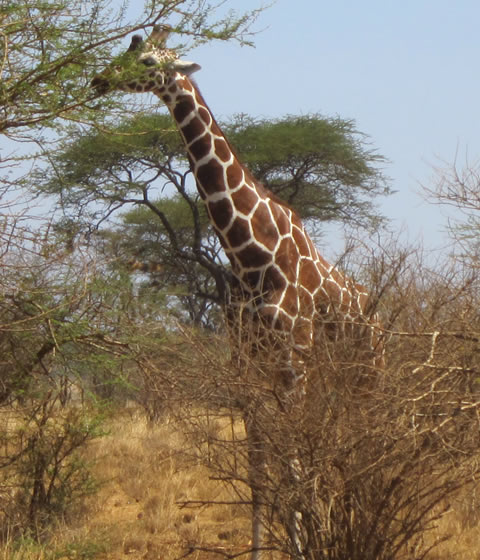 Giraffe at the Meru National Park
With more than 300 species recorded, Meru National Park is an excellent birding destination. It has several northern Kenya specials, including the impressive Somali ostrich, Boran cisticola and the vivid vulturine guineafowl. The noisy yellow-necked spurfowl is very common and the sought-after Hinde’s pied babbler can sometimes be spotted as well. The rivers running through the park offer the right habitat for Pel’s fishing-owl, the shy African finfoot and the localized golden palm weaver, as well as more common waterbirds.
Meru offers good bird watching throughout the year, but the best time is from November to April when the migrants from Europe and North Africa are present. This coincides with the breeding season when many species are nesting. Although good for birding, November and April tend to be very wet and are less productive times for general wildlife viewing, so December to March can be a better time.
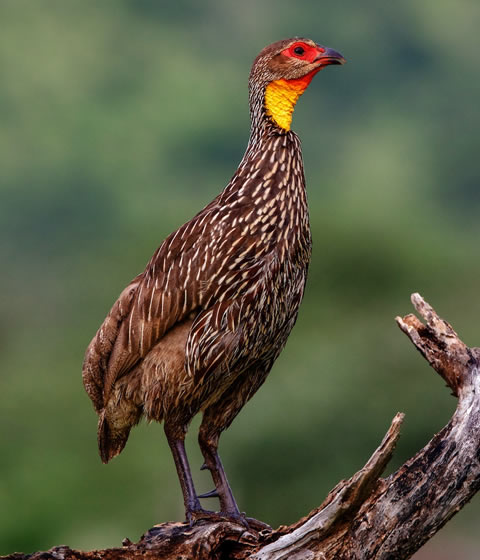 Yellow Necked Spurfowl at the Meru National Park


