


Bwindi Impenetrable Forest is a remnant of what once used to be a very large forest, covering areas of western Uganda, Rwanda, Burundi and eastern Democratic Republic of Congo. The forest is home to numerous globally threatened species, including the mountain gorilla, chimpanzee, L’Hoest’s monkey and the African elephant. Bird enthusiasts can look forward to sightings of the Africa green broadbill, Grauer’s swamp warbler, Turner’s Eremomela, Chapin’s flycatcher and Shelley’s crimson-wing. The area is known as the most important forest in Africa for the montane forest butterflies, including African giant swallowtail and Cream-banded swallowtail.
The primary attraction in the park is the mountain gorillas. This population of around 340 individuals is half of the world's entire population. They are endangered, yet here there are 4 groups that are habituated to the presence of humans in their natural habitat. The Bwindi Impenetrable National Park is a UNESCO World Heritage Site, celebrated for its biodiversity and floral kingdom. It has one of the richest ecosystems in Africa. The forest acts as an important water catchment where streams and rivers provide water to the surrounding densely populated agricultural land. Visitors can visit the park any time throughout the year, although conditions in the park are more difficult during the rainy season. Please note that guests need a permit for gorilla trekking.
The main attraction in Bwindi is its mountain gorillas. Of its population of approximately 400 individuals, more than a hundred are habituated. Bwindi has more than 120 mammal species, but most of these are small forest creatures. Elephant is present, although they are rarely seen. More regularly encountered are bushbuck and several types of duiker. Bwindi contains a huge number of threatened species and is therefore considered a hot spot in conservation. Butterflies are something of a specialty, with an impressive list of 220 species, of which three only occur in the park. Bwindi is home to 10 primate species, including the rare L'Hoest's monkey and black-and-white colobus. Chimpanzee are present but not habituated and therefore rarely seen.
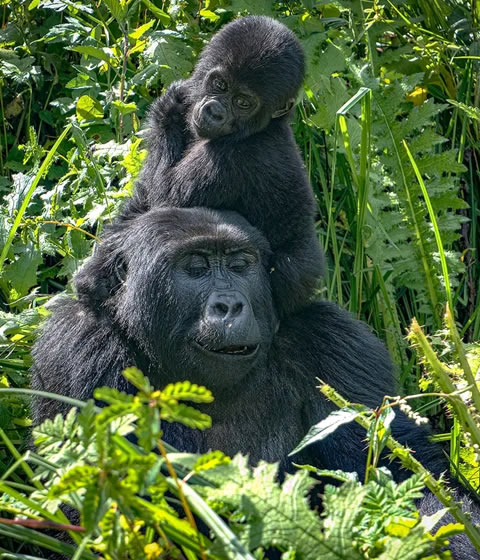 A view of the Bwindi Impenetrable Forest
Bwindi should be on every birder’s itinerary. The park offers some of the best montane-forest (mountain-forest) bird watching in Africa. There are an estimated 350 bird species, with 14 not recorded anywhere else in Uganda. There are 23 birds unique to the Albertine Rift (which is 90% of all Albertine Rift endemics), including Neumann's warbler and blue-headed sunbird. Migratory birds are present from November to April. The birdlife in Bwindi is good year-round, but at its best in March and September. June and July have the least rain while March to mid-May has the most. Heavy rains might interfere with your bird-watching time. The main nesting season is in May and June, with food being abundant from late May through September. Migratory birds, though not a significant part of Bwindi’s attraction to birders, are present from November to April.
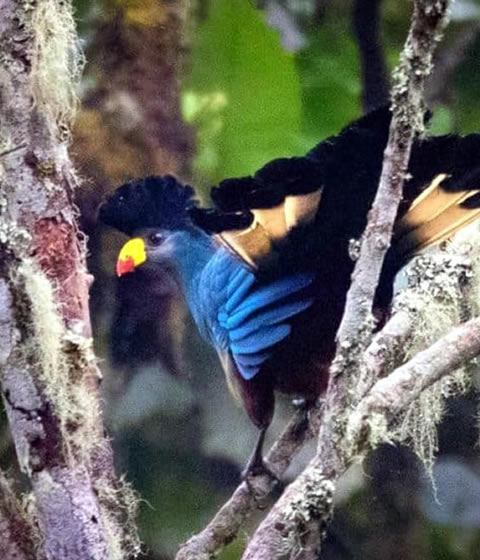 Great Blue Turaco at the Bwindi Impenetrable Forest


